
What does overpayment mean on taxes? It means you paid more federal tax, estimated taxes, or tax withholding than you actually owed on your tax return.
For 1099 contractors, CRNAs, locum tenens professionals, nurse practitioners, and other self-employed professionals, tax overpayments often result from excessive estimated tax payments, income fluctuations throughout the year, or deductions that are not fully accounted for before payments are made.
A tax overpayment is usually better than an underpayment because it may result in a refund instead of penalties. However, overpaying too much can also create cash flow issues.
This guide explains what overpayment of tax means, how to know if you overpaid tax, whether you will get it back, and how to avoid paying too much or too little throughout the year.
Defining Tax Overpayment for the Self-Employed

A tax overpayment happens when your total tax payments are higher than your final tax liability.
This may happen because of:
- Too much federal tax withheld from W-2 income
- Estimated tax payments that were higher than needed
- Tax credits that reduced the final amount owed
- Prior-year overpayments applied to the current year
- Duplicate or incorrect tax payments
For self-employed professionals, this often happens with estimated taxes. Since 1099 income does not usually have tax withheld automatically, many contractors pay quarterly taxes based on projections. If those projections are too high, an estimated tax overpayment can happen.
How to Know If You Overpaid Tax
The most common sign that you overpaid tax is a refund on your tax return.
To confirm, compare your total tax payments against your total tax owed. Your tax payments may include federal withholding, estimated tax payments, extension payments, refundable credits, and any prior-year overpayment applied to the current year.
You can also use the IRS tool to check your federal tax refund status after filing.
Check Your Tax Return and Refund Amount
Your tax return will show whether you have a balance due, a refund, or an amount applied to next year’s taxes.
In some cases, the IRS may also correct a return or adjust the refund amount. That is why the refund shown on the return should be compared with IRS notices, bank deposits, and payment records.
Review Estimated Taxes and Quarterly Payments
Self-employed professionals often pay estimated taxes throughout the year.
Overpayment typically occurs when:
- Income decreases after calculating estimated payments
- Quarterly taxes are based on old projections
- Deductions are not included in the estimate
- A prior-year refund is applied forward
- Payments are duplicated or entered incorrectly
For 1099 contractors, estimated tax payments should be reviewed during the year, not only after filing.
You can also review our guide on estimated tax deadlines for 1099 contractors to better understand quarterly payment timing.
If I Overpay Taxes, Will I Get It Back?
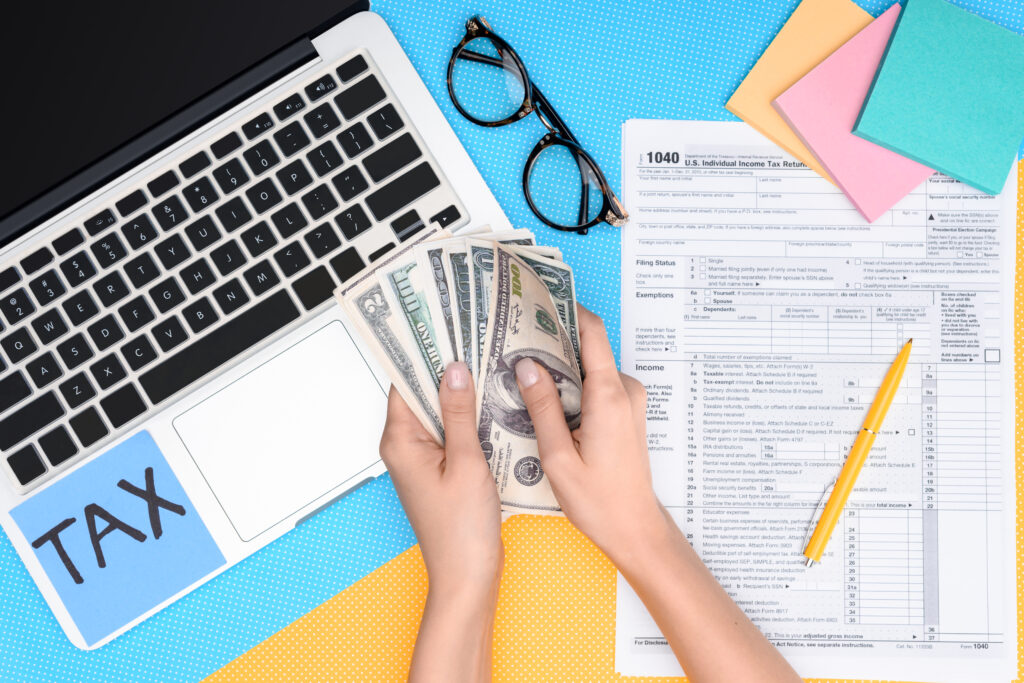
Usually, yes. If your tax return shows an overpayment, you may receive a tax refund or apply the amount to next year’s estimated taxes.
However, the refund may be reduced or delayed if the IRS applies it to another balance. This may include prior tax debt, certain state debts, child support, or other eligible offsets.
The IRS explains more about IRS refund and overpayment rules.
Refund vs. Applying Overpayment to Next Year
If you overpay taxes, you may usually choose between receiving a refund or applying the overpayment to next year’s tax payments.
A refund may help with current cash flow. This can be useful if you need the money for business expenses, savings, payroll, or personal obligations.
Applying the overpayment forward may make sense if you expect another high-income year or want to reduce upcoming estimated tax payments. Some 1099 professionals prefer this option because it helps lower the next quarter’s tax burden.
However, the better choice depends on your cash flow, income expectations, and current tax situation.
When a Refund May Be Reduced or Delayed
A refund may be reduced or delayed for several reasons.
Common causes include:
- Prior federal tax balances
- State tax debts
- Child support or other eligible offsets
- IRS corrections to the return
- Incorrect bank account information
- Amended returns
- Payment mismatches or misapplied payments
If you receive an IRS notice, read it carefully and compare it with your own records. The IRS may send a notice if payments applied to your account do not match the payments claimed on your return.
Is It Better to Overpay or Underpay Taxes?

It is generally safer to overpay than to underpay taxes since it helps avoid any unnecessary penalties and surprise tax bills. If your tax payments are ahead of your final liability, you may feel less pressure when filing your tax return.
However, overpaying too much can limit cash flow. For business owners and 1099 professionals, that money could have been used for business expenses, payroll, retirement savings, emergency reserves, or debt reduction.
Underpaying taxes could present an even larger problem. If you do not pay enough tax during the year, you may owe the remaining balance at filing time, plus penalties and interest. This matters for 1099 contractors because taxes are not automatically withheld from most contractor payments.
The goal is not a huge refund or a large balance due. The goal is accurate tax planning.
How 1099 Professionals Can Avoid Overpaying or Underpaying
1099 professionals can avoid overpaying or underpaying by tracking income, reviewing estimated tax payments, and updating their tax plan when income changes.
This is especially important for CRNAs, locum tenens professionals, and healthcare contractors because income may vary by assignment, state, and contract.
Adjust Estimated Taxes When Income Changes
Estimated taxes should reflect your actual income pattern.
A high-income quarter may not represent the whole year. A slow quarter may also require recalculating payments so you do not continue paying too much.
In most cases we see, the issue is not that the taxpayer wants to overpay. The issue is that estimated payments were never adjusted after income changed.
If you also filed late or paid the wrong amount, review our guide on Tax Extension for 1099 Contractors: What to Do If You Filed Late or Paid Wrong in 2026.
Use Bookkeeping to Make Better Tax Decisions
Accurate books help calculate estimated taxes more clearly.
Clean bookkeeping shows income, deductions, business expenses, and cash flow. As a result, tax planning becomes less of a guess.
For 1099 contractors, bookkeeping also supports deduction review and helps reduce both overpayment and underpayment risk. For ongoing support, explore bookkeeping for 1099 contractors.
What to Do If You Already Overpaid Taxes

If you already overpaid taxes, start by filing your tax return accurately.
Your return should show whether the overpayment will be refunded or applied to next year’s taxes. Then, review your estimated tax payments before the next deadline so the same issue does not repeat.
You may also need to update Form W-4 if you have W-2 income in addition to your 1099 work.
Review IRS Notices Carefully
IRS notices may show payment differences, refund changes, or overpayment adjustments.
If you receive an IRS notice about payment differences, compare the notice against your tax return, estimated tax payment confirmations, bank records, and prior-year carryforwards.
If the IRS applied a payment differently than expected, your records can help identify whether the payment was duplicated, misapplied, or entered incorrectly.
Get Tax Planning Help Before the Next Estimated Tax Deadline
If you are a CRNA, locum tenens provider, nurse practitioner, or 1099 healthcare professional, your income may change from quarter to quarter. That makes tax planning more important than guessing.
1099 Accountant can help review your estimated taxes, tax payments, bookkeeping, and year-end strategy so you can avoid overpaying too much or underpaying and facing penalties.
For year-round support, schedule a consultation or contact us at (855)529-1099 today.