
Tax planning for 1099 contractors involves tracking income, estimated tax payments, business expenses, self-employment tax, and bookkeeping throughout the year. In other words, it is not just about receiving one tax form
Freelancers, single-member LLC owners, independent contractors, and healthcare contractors may get different forms. This depends on how clients, agencies, facilities, and payment platforms pay them. Nonetheless, they must also record income that does not appear on a tax form and maintain records for business deductions.
The IRS explains that independent contractors must complete the right forms after they set worker status. In addition, they must also pay the related taxes. Therefore, your recordkeeping system should operate throughout the year, not begin when tax forms arrive. Review the IRS independent contractor tax forms for an overview.
Quick Comparison table: Key Forms for 1099 Contractors
| Form | What it is used for | Who usually sends or files it | Why it matters |
| W-9 | Provides taxpayer information | Contractor gives it to the payer | Helps the payer prepare tax forms |
| 1099-NEC | Reports nonemployee compensation | Client sends it to the contractor and IRS | Reports contractor service income |
| 1099-MISC | Reports certain miscellaneous payments | Payer sends it to the recipient and IRS | May report rent, awards, or medical payments |
| 1099-K | Reports payment card and platform transactions | Processor, app, or marketplace sends it | Helps reconcile platform income |
| 1099-INT | Reports interest income | Bank or financial institution sends it | Affects the full tax return |
| Schedule C | Reports business profit or loss | Contractor files it with Form 1040 | Reports business income and expenses |
| Schedule SE | Calculates self-employment tax | Contractor files it with Form 1040 | Calculates tax on net self-employment earnings |
| Form 1040-ES | Calculates estimated tax | Contractor uses it during the year | Helps plan and pay estimated taxes |
| Form 1120-S | Reports S-Corp activity | S-Corp files it annually | Applies to businesses taxed as S-Corps |
Form W-9 and Form 1099-NEC: Essential Forms for Contractor Payments

Before work begins, contractors usually provide Form W-9 to the client, agency, facility, or payment platform. The form gives the payer the contractor’s legal or business name, address, tax identification number, and federal tax classification.
After year-end, clients may use Form 1099-NEC to report contractor compensation. When reviewing either form, confirm the name, EIN or SSN, entity classification, reported amount, and whether reimbursements were included. Then, compare the information with your bookkeeping records.
Review the IRS Form 1099-NEC guidance for more information.
Form 1099-MISC, Form 1099-K, and Other Forms You May Receive
Form 1099-MISC is no longer the main form for contractor service income. However, it may still report rents, prizes, awards, other income, or certain medical and healthcare payments.
Contractors may also receive Form 1099-K for card payments or business transactions. These are processed through payment apps, marketplaces, and third-party networks. Because the same payment may appear on both Form 1099-NEC and Form 1099-K, compare each form to your records. Specifically, review your contracts, bank activity, and bookkeeping records to avoid counting income twice.
Other forms may include 1099-INT, 1099-DIV, 1099-B, 1099-R, 1099-G, and 1099-SA. These are not usually contractor service-income forms, but they may still affect the complete federal or state tax return.
Schedule C and Schedule SE: Reporting Profit and Self-Employment Tax
Sole proprietors and many single-member LLC owners use Schedule C to report business income and deductible expenses. On the other hand, Schedule SE calculates self-employment tax based on net earnings from self-employment.
Contractors should retain records for income, business expenses. They should track mileage, travel, meals, and insurance costs. They should also keep records of reimbursements, professional dues, software, bookkeeping, and tax fees. These help support both profit reporting and self-employment tax calculations.
For more detail, review what Schedule C means for 1099 contractors and the IRS Schedule SE guidance.
Form 1040-ES and State Tax Records

Form 1040-ES helps 1099 contractors calculate and pay federal estimated taxes on income that is not subject to withholding. Payments are generally due April 15, June 15, September 15, and January 15 of the following year. These dates may change due to weekends and holidays.
Locum tenens providers and travel healthcare contractors who work across states should track key detail. This includes resident state, states worked, assignment dates, facility locations, income earned by state, withholding, reimbursements, and travel records. Accurate records support state tax planning because filing requirements vary by state.
Healthcare contractors can also review estimated taxes for CRNAs and locum tenens providers.
S-Corp Tax Forms and Payroll Records
A contractor operating through an S-Corp may need Form 1120-S, payroll records, W-2 wages, distribution records, shareholder basis information, and reasonable compensation support. Form 1120-S reports the corporation’s income, gains, losses, deductions, and credits.
A Schedule C contractor and an S-Corp owner do not report all business activity the same way. Therefore, contractors should confirm their current entity structure before changing forms, payroll, or payment practices.
For healthcare-specific planning, review S-Corp tax planning for high-income CRNAs.
The 1099 Contractor Tax Form Workflow
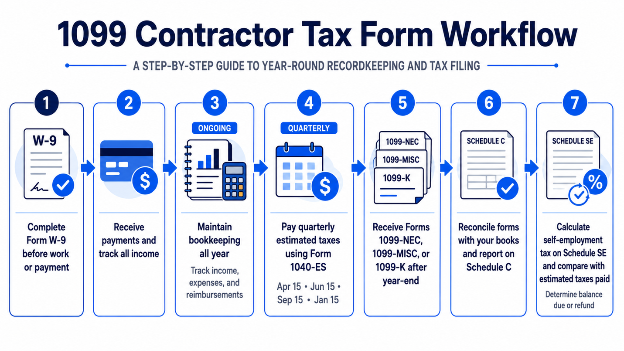
Work With 1099 Accountant to Organize Your Tax Forms and Records
Tax forms only show part of your financial activity. Clean bookkeeping for 1099 contractors helps verify income, deductions, reimbursements, estimated tax payments, and state activity while identifying missing forms, incorrect amounts, or duplicate income.
Whether you are a freelancer, CRNA, locum tenens provider, or healthcare contractor, clean bookkeeping can help reduce duplicate-income confusion, identify missing records, and prepare better information for tax filing.
1099 Accountant helps self-employed professionals organize contractor income, review tax forms, track estimated payments, and maintain accurate records throughout the year.
Schedule a consultation or contact us at (855) 529-1099 today.